I Gave Hermes and OpenClaw the Same Job for 30 Days. Only One Got Better.
Two of 2026's strongest agent stacks, the same repetitive workload, thirty days of real runs. One of them quietly rewired itself and pulled ahead — and the reason it won is the reason most agent comparisons ask the wrong question.
Here’s the result up front, because I hate articles that make you scroll for it: after thirty days of handing both agents the exact same recurring work, Hermes finished the same task roughly 65% faster than it did on day one. OpenClaw finished it in exactly the time it always had.
Neither agent got a smarter model. Neither got a new integration. Nothing about the underlying intelligence changed. One of them just kept the receipts — and that turned out to be the whole ballgame.
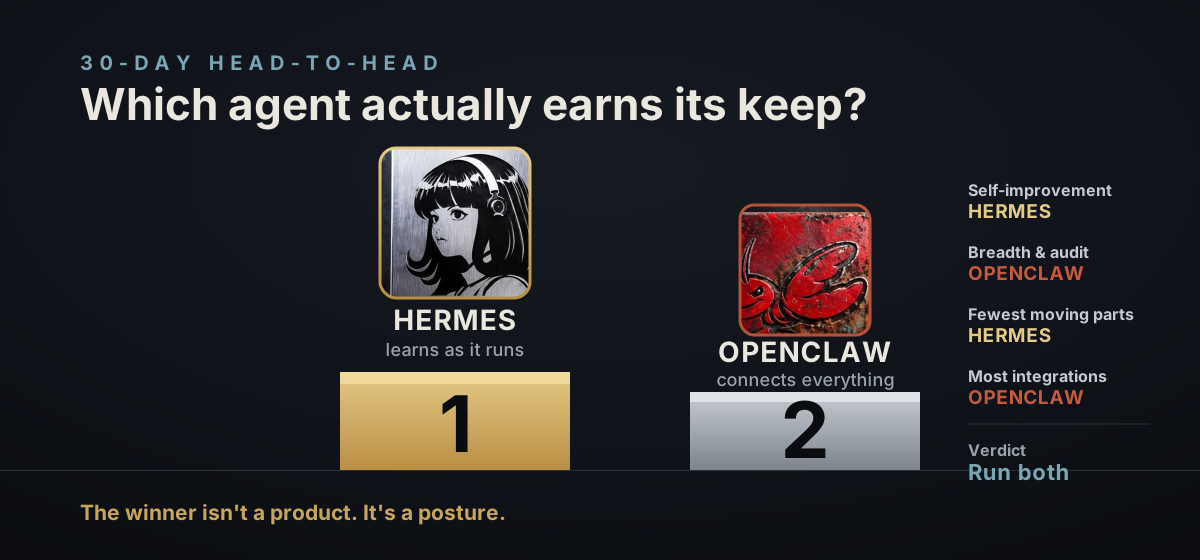
I run a fleet of agents for real delivery work — the kind of stuff described in my AI operating system — so this wasn’t a benchmark for a leaderboard. It was thirty days of me actually needing the output: lead research, competitive monitoring, code review, the email triage that eats a morning. Same prompts. Same repos. Same me, correcting the same mistakes. I just pointed the work at two different stacks and watched.
The contenders, in one breath each
Strip the marketing off both and they’re solving two genuinely different problems.
OpenClaw is connective tissue. It’s a gateway: messages come in from a dozen channels — Slack, WhatsApp, iMessage, email — and get routed to whatever model you point it at. Its memory is plain markdown files you can open, read, and edit. Its skill ecosystem is enormous — thousands of community skills, documentation that puts most vendors to shame. If your problem is “connect all these surfaces and give me total, auditable control,” OpenClaw is genuinely excellent, and I’m not going to pretend otherwise.
Hermes is a self-sharpening specialist. It wraps a model in a kernel that does one unusual thing: after a task finishes, it reviews what just happened and, if it spots a reusable pattern, writes itself a new skill. Next time similar work shows up, that skill is already there. Its integration list is shorter and its community catalog is smaller — but the agent you have on day 30 is not the agent you started with.
The only chart that matters
Every agent comparison you’ve read grades on the wrong axis: features, channels, price, model quality on day one. All of that is a snapshot. The thing that actually changed my month was the slope.
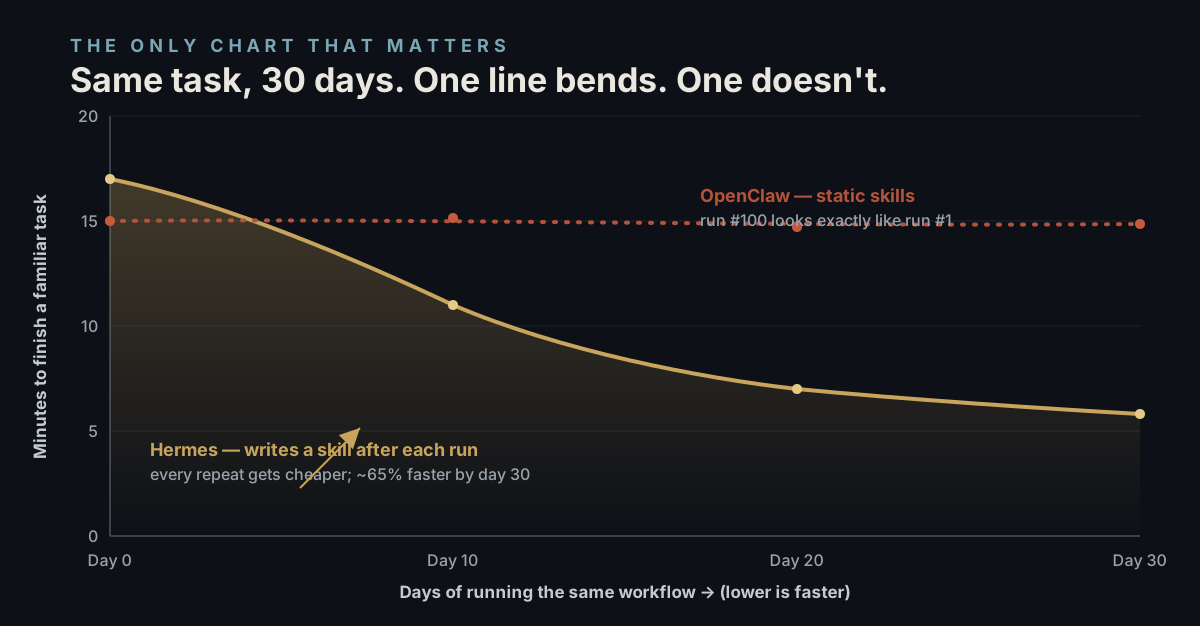
That gap isn’t intelligence. It’s memory made load-bearing. It’s the exact mechanism I wrote about in teaching agents to learn from losing — every correction becomes a rule the agent can’t forget, and after enough reps the workflow just gets cheap. Hermes has that loop baked in. OpenClaw, by design, does not: its skills are static and human-authored, so you get precisely the competence you wrote down, forever, until you sit down and write more.
Which sounds like a knock on OpenClaw. It isn’t — and here’s where I have to be fair.
Where OpenClaw quietly wins
I spent the month rooting for the learning curve, and OpenClaw still beat Hermes on four things that matter more than slope on the days they matter:
- Breadth of reach. Twenty-plus channels out of the box versus a handful. When the job is “be everywhere my customers are,” this isn’t close.
- Auditability. Markdown memory you can read line by line is a compliance dream. “Show me exactly what the agent knows and why” has a real answer.
- Ecosystem gravity. Thousands of skills means most common jobs are already solved. Hermes learns your workflow; OpenClaw arrives already knowing a thousand generic ones.
- Determinism. Static skills sound like a weakness until you need the agent to do the same regulated thing the same way on run #4,000. “It doesn’t drift” is a feature in the right room.
The honest framing isn’t “which agent is better.” It’s “which failure mode can you afford.” Hermes can wander as it learns. OpenClaw will never surprise you — including when you wish it would.
The twist I didn’t expect: the answer is “both”
Halfway through the month I stopped treating it as a cage match, because my own fleet had already quietly resolved it. If you read my adapter trilogy, you know the punchline: I run OpenClaw for its surface — the channels, the personas, the office I can watch agents work in — and it leans on a Hermes kernel underneath for the actual model calls and the memory.
So the production answer wrote itself. OpenClaw dispatches; Hermes specializes. The gateway meets the world across every channel and hands off; the kernel takes the repetitive, high-frequency work and gets measurably better at it every week. Neither one is the winner. The topology is the winner.
The tale of the tape
Thirty days, boiled down to one screen:
| Hermes | OpenClaw | |
|---|---|---|
| Core job | Self-sharpening specialist | Connective tissue |
| Learns from use | ✅ Writes a skill after each run | ❌ Static, human-authored |
| Same task, day 30 | ~65% faster than day 1 | Same as day 1 |
| Channels / reach | A handful | 20+ out of the box |
| Memory | Durable, compounding | Plain markdown, fully auditable |
| Skill ecosystem | Smaller, grows with you | Thousands, ready-made |
| Failure mode | Can wander while learning | Never surprises you — ever |
| Best when | Same work, endlessly | Reach, control, audit |
So who should pick what
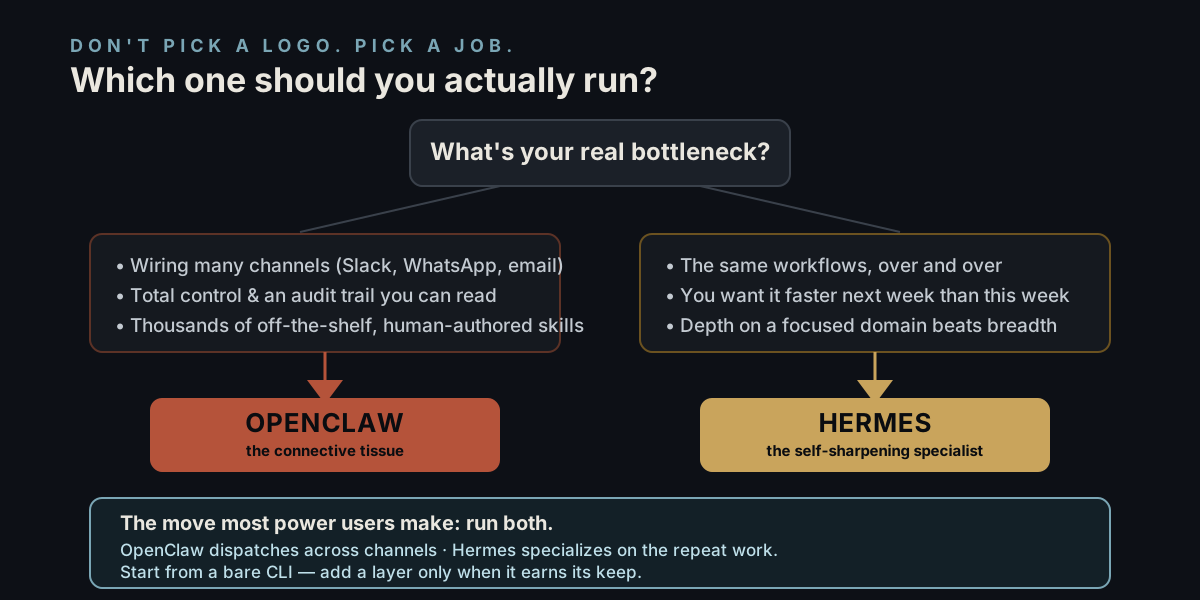
Cut to the decision, because that’s what you came for:
- Pick OpenClaw if your bottleneck is reach and trust: many channels, strict auditability, a big library of ready-made skills, and outputs that must be identical every time.
- Pick Hermes if your bottleneck is the same work, endlessly: focused workflows where a curve that bends down over a month is worth more than a catalog you’ll never fully use.
- Run both the moment you’re doing serious volume — which, if you’re reading this far, you probably are. Let the gateway connect and the kernel compound.
And whatever you choose: start bare. Point your agent at one local CLI you’ve already authenticated and ship something before you bolt on either of these. A gateway or a kernel is a layer between your agent and the model, and every layer is a liability you pay for on every heartbeat. Add one only when the coordination it buys is worth more than the fragility it introduces.
Steal this
If you only take three things from thirty days of watching:
- Grade agents on slope, not snapshot. Anyone can look good on day one. Ask what run #100 costs versus run #1. That single question reorders every comparison table you’ve seen.
- Memory is the moat, not the model. The stack that turns corrections and successes into durable, reusable skills will out-run a smarter model with amnesia. Build the loop; don’t wait for the vendor.
- Topology beats tribalism. “Hermes or OpenClaw” is a false fight. Breadth up top, depth underneath — the interesting question is how you wire them, not which one you delete.
Thirty days in, I don’t have a favorite agent. I have a favorite shape: connect widely, specialize deeply, and let the boring, repeated work quietly get cheaper while you sleep. The tools will keep changing. That shape won’t.