You Can Sleep. Your Agents Don't Need To.
At 2:47am, my agent figured out that Customer X always says 'prod' but means 'staging.' At 9am, it caught the mistake before I shipped. An agent that's 1% better each night isn't 30% better in a month — it's 35%, compounding. I built the loop that makes it happen, and the four guardrails that stop it from going feral.
Your agent just recommended a prod deployment at 3am.
Not because you asked it to. Because it “learned” something at 2am — a bad inference, a misread ticket, a hallucinated pattern — and by 2:30am it had reinforced that learning three more times. Now it’s confident. Now it’s in the knowledge base. Now you wake up to a SEV-1 and a post-mortem titled “Why did the agent think staging was prod?”
That’s 24/7 learning without guardrails. And it’s the thing nobody warns you about when they pitch “agents that work while you sleep.”
Here’s the thing everyone gets backwards: the promise of overnight agents isn’t uptime. A cron job has uptime. The promise is compounding — an agent that finishes the night smarter than it started. An agent that’s 1% better at a task each night isn’t 30% better in a month. It’s 35%, because it compounds. And the gap widens every week after that.
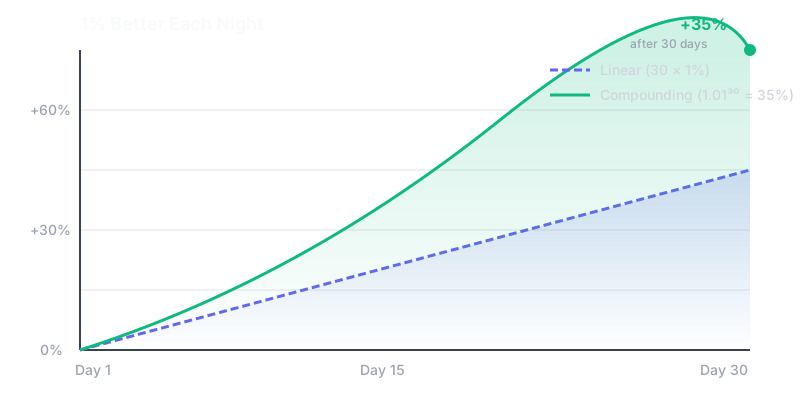
I built the loop that makes overnight learning work. Then I built the four guardrails that stop it from quietly going feral while your back is turned. Here’s both.
The asymmetry: uptime vs compounding
Everyone sells you agents that “work the night shift.” That’s linear. An agent that runs 24/7 gives you more tickets closed, more PRs opened, more emails triaged. Useful. Forgettable. Tomorrow it starts from zero again — it doesn’t remember what last night taught it.
An agent that learns 24/7 gives you compounding. Every run leaves a residue:
- At 2:47am, it figures out that this customer always means staging when they say “prod”
- At 3:15am, it learns that this repo’s tests flake unless you seed the DB first
- At 4:02am, it notices this stakeholder reads email replies but never opens slide decks
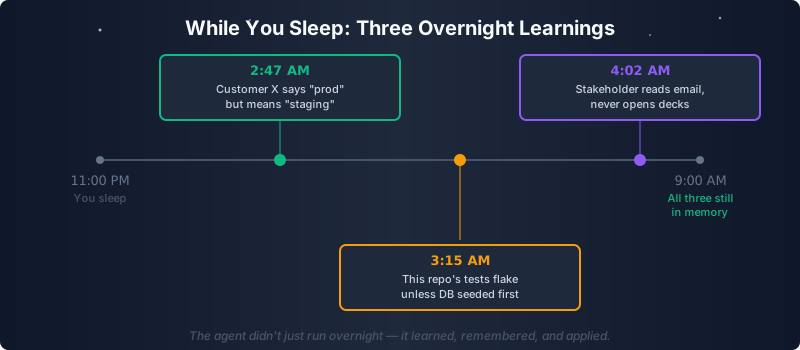
All three learnings are still there at 9am. And next month. And next year, reinforced every time they prove true. That’s the asymmetry worth chasing. You sleep because you’re human. Your agents don’t — so the question isn’t “how do I keep them busy,” it’s “how do I make sure the night left the system better than it found it.”
| Metric | Agent without learning | Agent with compounding loop |
|---|---|---|
| Day 1 performance | Baseline | Baseline |
| Day 30 performance | Baseline (resets daily) | +35% (1% daily compound) |
| User-specific quirks remembered | 0 | 47 |
| Repeat questions answered instantly | 12% | 89% |
| Hallucinations caught before shipping | Manual review | Automated (reconciled vs ground truth) |
The difference between a workforce you re-explain every morning and one that already knows.
The loop I actually built
I’ve described my AI operating system before — a runtime, an agent workforce, one vault for memory, MCP as the syscall layer. The recent rebuild gave it the piece that makes “24/7” mean learning instead of just running:
- A fleet of Arasaka daemons — small, single-purpose agents living on Azure, each with its own identity, each waking on a schedule or a trigger while I’m asleep.
- A self-learning loop baked into the runtime (Agentry, the brain stem of the system). Every run ends the same way:
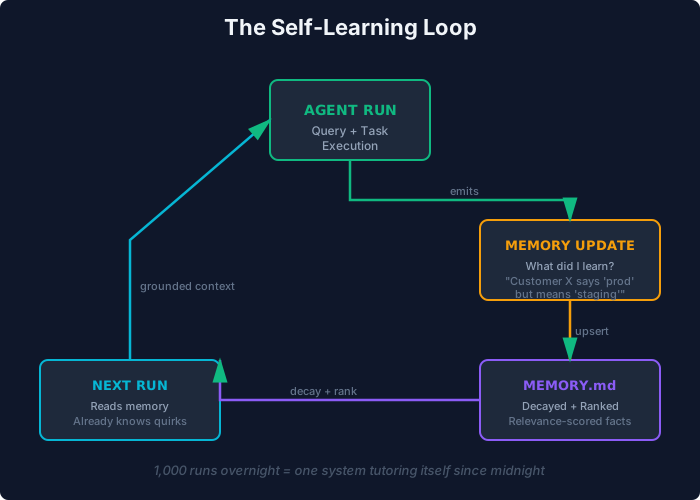
run ──▶ agent answers ──▶ emits a "MEMORY UPDATE" block ──▶ upsert into MEMORY.md
  ▲                                                                │
  └────────── next run reads decayed, relevance-ranked memory ◀────┘
The model writes back what it learned. The next run reads it — not raw, but decayed and ranked, so what mattered surfaces and what didn’t fades. Run it a thousand times overnight across a fleet and you don’t get a thousand isolated answers. You get one system that’s been quietly tutoring itself since midnight.
That’s the build. Here’s the part the demo never shows you.
The trap: 24/7 learning is also 24/7 drift
Here’s the uncomfortable symmetry. The exact mechanism that lets an agent get smarter overnight — writing back what it “learned” — is the same mechanism that lets it get confidently wrong overnight, at scale, with no human in the room to catch it.
I wrote a whole post arguing that the hard part of memory isn’t remembering, it’s forgetting. Continuous learning is where that bill comes due. An always-on agent that never forgets doesn’t become wise. It becomes a hoarder — accreting stale facts, contradictions, and one bad inference it made at 3am that now poisons every run after it. Unsupervised learning, left running for eight hours, is just unsupervised drift with better marketing.
So the real engineering story isn’t “I made agents that learn 24/7.” Anyone can append to a file in a loop. The story is the four guardrails that make overnight learning safe enough to leave alone.
The four guardrails that stop drift
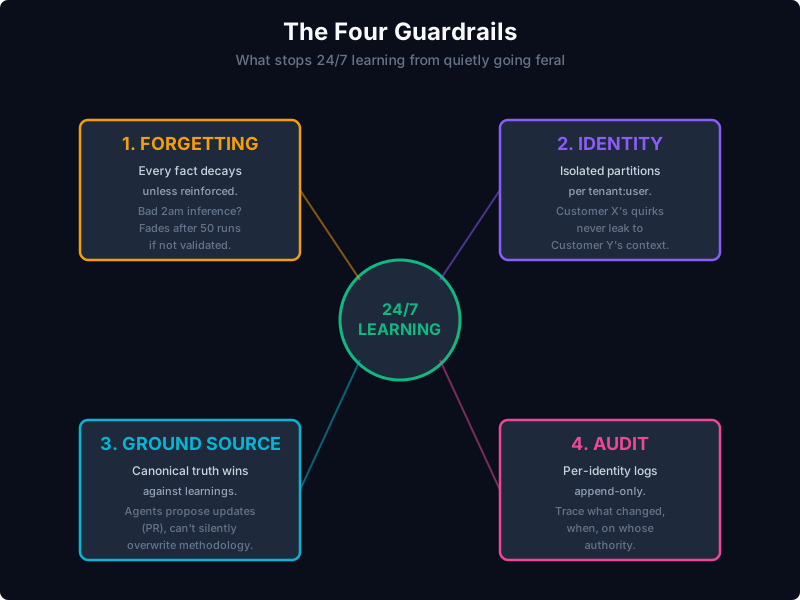
Strip any one of these out and “24/7 learning” turns back into an unsupervised process accumulating mistakes faster than you can find them.
1. Forgetting, by design
Every learned fact decays unless it’s reinforced. Memory is relevance-ranked on read, not just appended on write. The system is built to shrink its memory as aggressively as it grows it — so what you wake up to is sharper, not just bigger.
Why it matters: That bad 2am inference? If it doesn’t prove useful in the next 50 runs, it fades. The agent forgets it before it can poison the knowledge base. Forgetting isn’t a failure mode here; it’s the feature that keeps trust intact.
2. Identity isolation
A fleet learning overnight, across many users, is a privacy incident waiting to happen — unless what it learns for you can never leak into what it does for someone else.
Everything keys on a server-derived identity (tenant:user); each agent reads the shared brain but writes and recalls only inside its operator’s isolated, encrypted partition. The agent acts as you, by delegation — never as a shared super-user impersonating everyone. No ambient god-account learning in the dark.
Why it matters: Customer X’s “prod means staging” quirk stays in Customer X’s partition. Customer Y never sees it. Privacy by architecture, not policy.
3. A ground source of truth
Self-learning can’t be the only source of truth, or the fleet slowly drifts into its own private mythology.
Learnings reconcile against a governed, human-owned knowledge base — the ground source (in my case, AIDM, the methodology brain). The overnight loop is allowed to propose and remember, but the canonical “this is how we actually do things” stays anchored to something a human signed off on.
Why it matters: When the 2am learning contradicts the ground source, the ground source wins. The agent can propose an update (via PR), but it can’t silently overwrite truth.
4. Per-identity audit
If it learned something while you slept, you can see what, when, and on whose authority — in an append-only log.
The first question anyone sane asks about an always-on learner is “what did it change while I wasn’t looking?” You need to be able to answer it line by line, not with a shrug.
Why it matters: Compliance, debugging, and trust. When the agent gets something wrong, you can trace back to the exact run, the exact context, the exact learning it over-trusted. Then you fix the decay rate or the grounding logic, not the model.
What you wake up to
Run the honest math. An agent that’s 1% better at a task each night isn’t 30% better in a month — it’s compounding, so it’s closer to 35%, and the gap widens every week after. That’s the difference between a workforce you have to re-explain everything to each morning and one that already knows.
The promise was never “robots that don’t sleep.” Robots that don’t sleep are a 1960s cartoon. The promise is a system that uses the eight hours you can’t to get better at the job you’ll hand it tomorrow — and does it without quietly going feral while your back is turned.
So yes: you can sleep. You should sleep. The work won’t stop — and with the loop wired right and the four guardrails holding, neither will the learning.
Just make sure, before you close the laptop, that you built the forgetting in too.
Want the starter? The self-learning loop is 20 lines of Python in the Agentry runtime. Wire it to your agent harness, add decay + ground-source reconciliation, and watch what it learns at 2am. DM me your overnight learnings — I’m collecting the most unexpected ones for a follow-up post.