The Model Isn't the Edge. The Harness Is.
Two teams. Same model. One ships an agent that runs your delivery practice; the other ships a chatbot that forgets your name. The gap isn't the model — it's the harness. Here's the discipline nobody named yet.
Two teams. Same model. Same budget. One ships an agent that runs a delivery practice overnight. The other ships a chatbot that forgets your name between turns. The whole gap is the harness — the engineered system around the model. This is the discipline nobody named, until everybody needed it.
Last week I told you about agents that learn while you sleep — the compounding loop, the four guardrails, the 2:47am learning that caught a bad deploy before I shipped it.
A dozen of you replied with some version of the same question:
“Okay. But what is the thing the loop actually runs inside? What did you build that makes any of this hold together?”
It has a name now. And once you see it, you can’t unsee it in every agent project that quietly failed.
It’s the harness.
The benchmark everyone’s staring at is the wrong one
Walk into any AI strategy meeting in 2026 and you’ll hear the same argument. Which model. Opus or the new open-weight challenger. This benchmark, that eval, this context window, that price-per-token.
Everyone is squinting at the engine.
Nobody is looking at the car.
Here’s the uncomfortable data point: take the same frontier model, hand it to two teams, give them the same problem and the same month. One team ships an agent that triages a backlog, reconciles it against a methodology, and files reviewable PRs while they sleep. The other ships a clever demo that dazzles for ten minutes and falls apart the moment a tool call times out.
Same model. Same weights. Same benchmark scores.
The entire difference is the harness.
The model was never the edge. It’s a rented commodity — you and your competitor can both call the same endpoint by Friday. What you can’t rent is the engineered system you wrap around it. That’s the part with your fingerprints on it. That’s the part that compounds.
What “harness” actually means
The word gets thrown around loosely, so let me make it concrete. The harness is everything that turns a model — which is fundamentally a stateless function that maps text to text — into something that can do a job over time.
It’s the loop. The tools. The state that survives a restart. The retries when a call fails. The memory that persists across sessions. The definition of “done” the agent can’t fake its way past. The recovery path when step four of a seven-step task falls over at 3am with nobody watching.
A prompt is a sentence. Context is a briefing. A harness is a nervous system.
Here’s the progression, because it’s the whole story in three words:
Prompt → Context → Harness.
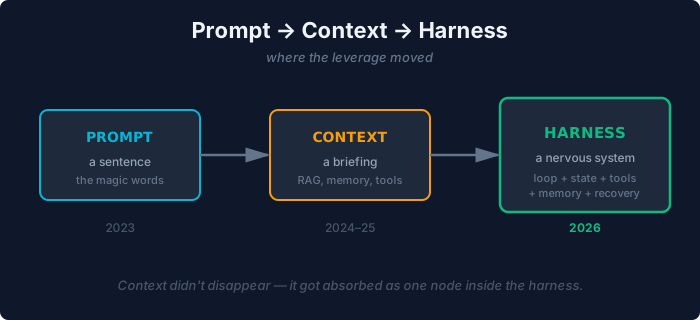
We spent 2023 optimising the prompt — the magic words, the few-shot examples, the “you are an expert” incantations. We spent 2024–25 discovering context — RAG, memory, tool outputs, getting the right material in front of the model. Both real. Both necessary. Both, it turns out, not the job.
Because here’s the nuance most people miss: context engineering didn’t disappear when harness engineering arrived. It got absorbed. Assembling the right inputs is now one node in a much bigger loop — the step where the agent gathers what it needs before it reasons and acts. Vital. But it’s a single organ, not the body. The frontier moved from “what do I feed the model” to “what is the system the model lives inside.”
If your mental model still stops at “I’ve got great RAG,” you’re optimising the briefing while your competitor is building the nervous system.
The anatomy of a harness
Strip my whole operating system down and the harness is a loop with six beats:
- Plan — turn an intent into a task tree
- Context — assemble memory, retrieval, and tools (yes — this is where context engineering now lives)
- Reason — let the model decide the next step
- Act — make the tool calls, cause the side effects
- Observe — capture what actually happened
- Learn — write the residue back to memory (this is the loop from last week’s post)
Then it goes around again. And again. A thousand times overnight across a fleet.
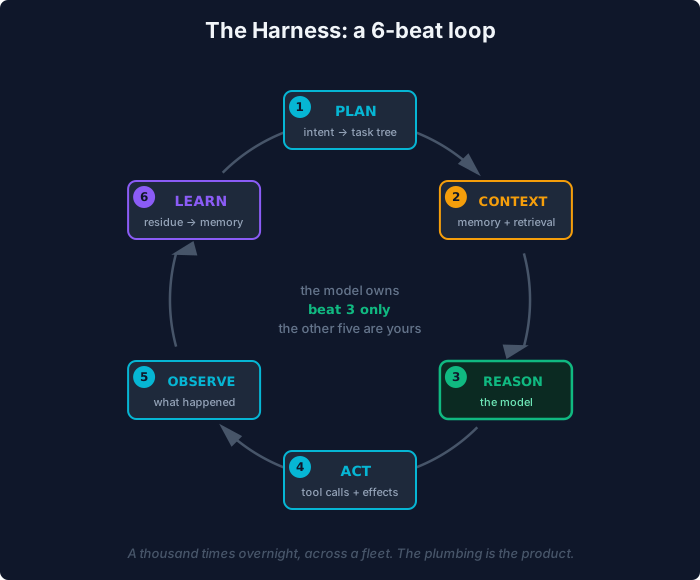
The model only owns beat three. The other five are yours to engineer — and they’re where every agent project lives or dies. The teams that lose are the ones who poured all their energy into beat three (prompt-tuning, model-shopping) and treated the other five as plumbing they’d “figure out later.”
Later never comes. The plumbing is the product.
What separates a real harness from a weekend demo
I’ve now built enough of these — and watched enough of them rot — to name the four things that actually distinguish a harness you can leave running from a toy you have to babysit.
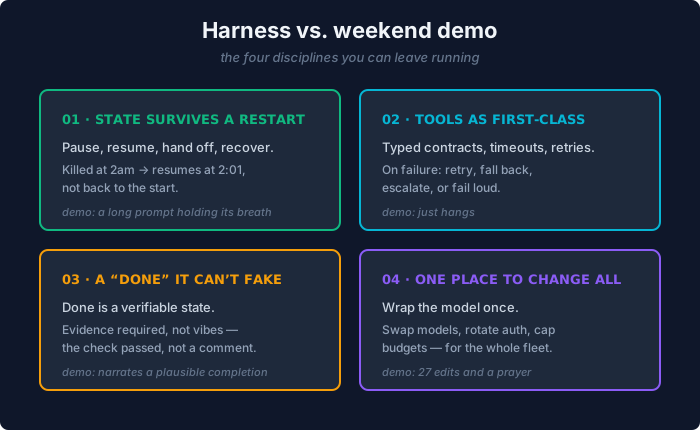
1. State that survives a restart
A demo holds everything in one heroic mega-prompt. Beautiful, until the process dies and takes the entire run with it. A real harness externalises state — it can pause, resume, hand off, and recover. The night-shift agent that lost power at 2am should pick up at 2:01 exactly where it left off, not start the eight-hour job over.
If your agent can’t survive being killed and restarted mid-task, you don’t have a harness. You have a long prompt holding its breath.
2. Tools as first-class citizens, not string-parsing
The line between “chatbot” and “agent” is the ability to act — and acting means tool calls with typed contracts, timeouts, and retries. When a tool fails (it will), the harness decides: retry, fall back, escalate, or fail loud. The demo just hangs. MCP gave us a clean syscall layer for this; the harness is what decides what to do when the syscall returns an error.
3. A definition of “done” the agent can’t fake
The single most expensive failure mode in agent systems: an agent that says it’s done because saying so is easier than being done. A real harness makes “done” a verifiable state — evidence required, not vibes. “I closed the ticket” must mean the ticket is closed and the check passed, not that the agent narrated a plausible-sounding completion into a comment box.
This is the same instinct as the guardrails that stop overnight drift: the system has to be honest with itself, structurally, when no human is in the room.
4. One place to change everything
Wrap the model once, in the harness, and you can swap models, rotate auth, cap budgets, and change behaviour for your entire fleet in a single place. Bolt the model directly into 27 agents and every change becomes 27 edits and a prayer. The harness is the difference between governing a fleet and herding one.
This is also why “which model” is the wrong fight. With a real harness, the model is a config value. You move from Opus to the next thing in an afternoon. The advantage was never which engine you bolted in — it was that you built a chassis you can drop any engine into.
The part Microsoft just validated
Here’s what made me sit up. I’d been calling this “harness engineering” for months as my own framing. Then I watched the major platforms converge on the exact same shape.
The agent harness is now a first-class concept in the tooling — context compaction, instruction merging, todo tracking, pluggable providers, all treated as the engineered layer that matters. Governance specs are going vendor-neutral and portable. Evaluation is being reframed as a continuous process that scores every harness change, not a one-time benchmark. Observability is becoming the assumed substrate — one trace pipeline through every model call, tool hop, and handoff.
Strip the branding off any of it and you get the same five-beat loop, the same four disciplines. When the independent practitioner’s whiteboard and the platform vendor’s GA roadmap draw the same diagram, that’s not a coincidence. That’s an industry discovering its real unit of work at the same time.
The leverage moved. Prompt engineering was a 2023 job title. Context engineering was a 2024 skill. Harness engineering is the 2026 discipline — and most teams are still hiring for the first one.
Where teams actually are (and where they think they are)
Be honest about which rung you’re on:
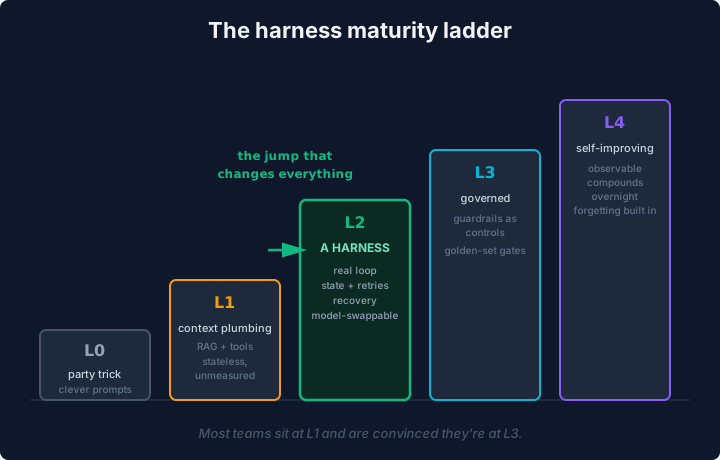
| Level | What it looks like | What it actually is |
|---|---|---|
| L0 | Clever prompts, copy-pasted between tools | A party trick |
| L1 | RAG + tools wired in, better answers | Context plumbing — still stateless, still unmeasured |
| L2 | A real loop: state, retries, recovery, model-swappable | A harness |
| L3 | Guardrails as controls, golden-set gates on every change | Governed |
| L4 | Observable, compounding overnight, with forgetting built in | Self-improving |
Most teams sit at L1 and are convinced they’re at L3. They have great retrieval and a slide that says “agentic.” They’ve optimised the briefing and never built the nervous system.
The jump that changes everything isn’t L3 → L4. It’s L1 → L2 — the moment you stop tuning prompts and start engineering the loop. That’s the jump from a demo that impresses your boss to a system that does the work.
The one-line version
Stop shopping for a better model.
Start engineering the system the model lives inside.
The model is rented. The context is one node. The harness is the edge — the part with your fingerprints on it, the part that survives a restart, the part that compounds while you sleep.
You can swap the engine in an afternoon. You can’t swap the chassis. So build the chassis.
Want to see the loop? The six-beat harness — and the self-learning loop that rides on top of it — is wired into my operating system runtime. I’m mapping the full architecture (harness, governance, evals, observability) onto both an open stack and a Microsoft-majority one in the next post.
If you’re running agents in production: what rung are you actually on — and what’s the one harness decision that moved you up a level? DM me. I’m collecting the sharpest answers for the follow-up.